
Every mic locker in America has a drawer full of 57s and 58s, and we were all taught the same rule: when in doubt, grab the Shure. Fifty years of being dropped, thrown, and used as a hammer earned that rule. So instead of telling you a story about which mic “won,” let’s do something more useful. Look at the curves.
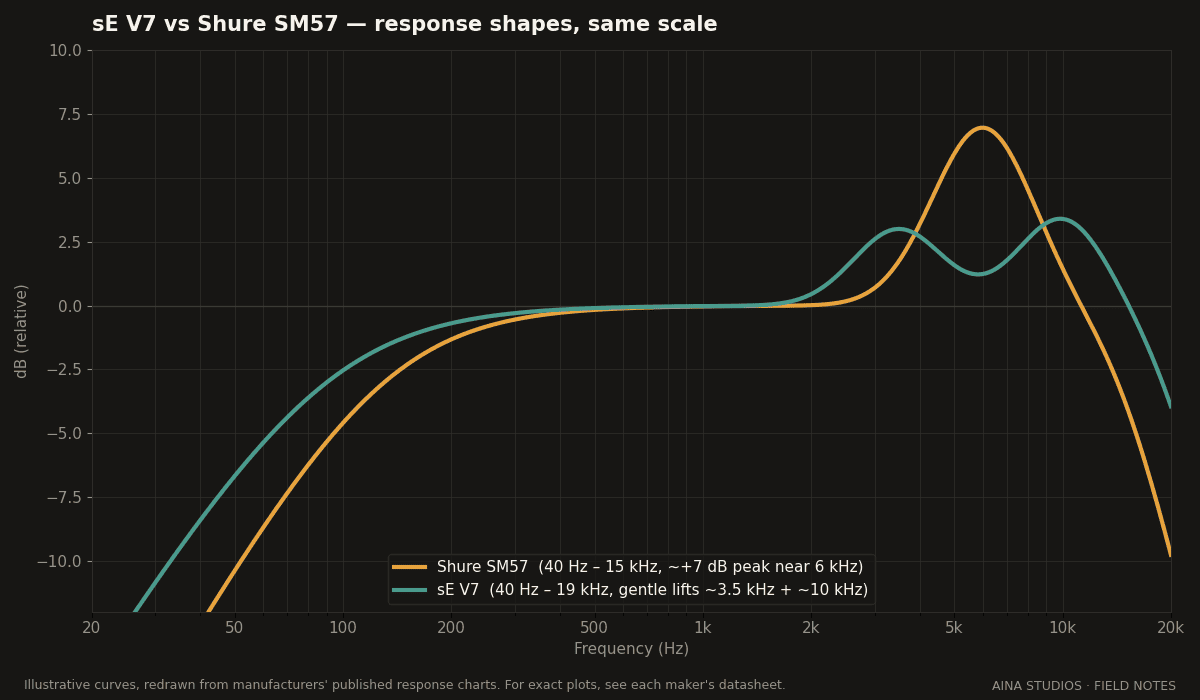
Reading the orange line (SM57): 40 Hz to 15 kHz, with that famous presence peak — roughly +7 dB centered near 6 kHz — then it falls off a cliff. That peak is the whole personality. It’s why a 57 cuts through a dense mix on snare and guitar amps, and it’s also why a 57 vocal can read as “forward” instead of “open.” There’s not much mic above 15k. There doesn’t need to be for a snare.
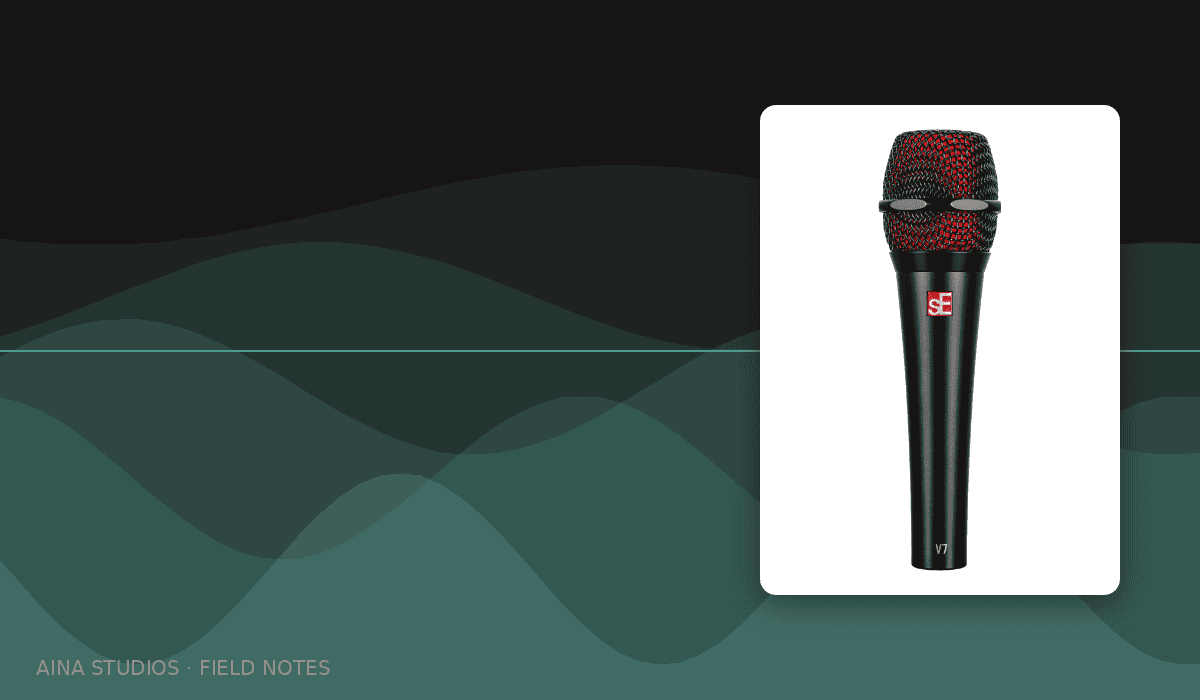
Reading the teal line (V7): 40 Hz to 19 kHz, and instead of one big peak, two gentle lifts — one around 3.5 kHz for intelligibility, one around 10 kHz for air. That second lift is the part you hear as “expensive.” Add the supercardioid pattern — tighter than the Shure’s cardioid — and on paper you get more gain before feedback and less of the drummer living in the vocal channel. That’s not a hot take. That’s what tighter patterns do.
So which one: for a lead vocal on a loud stage, the V7’s chart is simply shaped more like the job — air on top, controlled pattern, no 6k spike to tame. For snare and amps, the 57’s midrange wall is the job, which is why it stays undefeated there. And the 57 is still cheaper, more common, and more forgiving of singers with wandering technique — a supercardioid punishes people who drift off-axis.
Don’t take my word for it — that’s the point. The charts are public. Match the curve to the job and half the mic debate disappears.
Gear in this post
Shure SM57 — Amazon
sE Electronics V7 supercardioid dynamic vocal mic — check the current price on Amazon
Heads up: affiliate links. If you buy through them, Aina Studios earns a small commission at no extra cost to you — it helps keep this training free.